Search This Blog

Welcome!

Thank you so much for taking time out of your busy day to visit our blog. We would like to invite you to contribute your ideas related to professional development in this forum. We hope to offer all teachers at BHS the opportunity to have input in the PD you are experiencing this year, and to reflect on ideas and practices of our outstanding faculty.

Saturday, February 25, 2012

Jordana Anderson: An Exceptional Teacher at BHS

Recently, we announced that our PD Team Leads would be nominating teachers to highlight on this blog, recognizing them for efforts to address the critical academic needs of our students.  This month, the PD leaders nominated Jordana Anderson, English teacher from BIHS.

If you have ever had the opportunity to see Ms. Anderson in action, you understand how lucky we are to count among us such a gifted educator.  Her colleagues in BIHS know how humble she is, so she would never toot her own horn, but as I have had the opportunity to observe her on three different occasions,  I can attest to her extraordinary ability to hold high expectations in an engaging, relaxed atmosphere.

Ms. Anderson also recognizes the need to scaffold her instruction so that students at every level can access her curriculum.  One of the ways she does this consistently is by making use of her Constructing Meaning PD training from this year.  On any given day, an observer could walk into Ms. Anderson's classroom and witness a veritable cafeteria of approaches to improve the academic language of our students.

Each day, Ms. Anderson posts a learning goal and an agenda that includes the academic language her students will be expected to produce.  Here is a snapshot of her white board from a typical assignment.  When I first observed Ms. Anderson's well-organized class, I found myself thinking about how I could more effectively articulate student learning goals and explicitly teach academic language skills to my students.

Another thing that impressed me about Ms. Anderson was her ability to clearly convey assignment instructions to students.  She communicates instructions both verbally to the whole class and in writing on her white board.  She is also adept at checking for understanding.  She generously invites students into her classroom for help during lunch and after school, and provides differentiation for all.
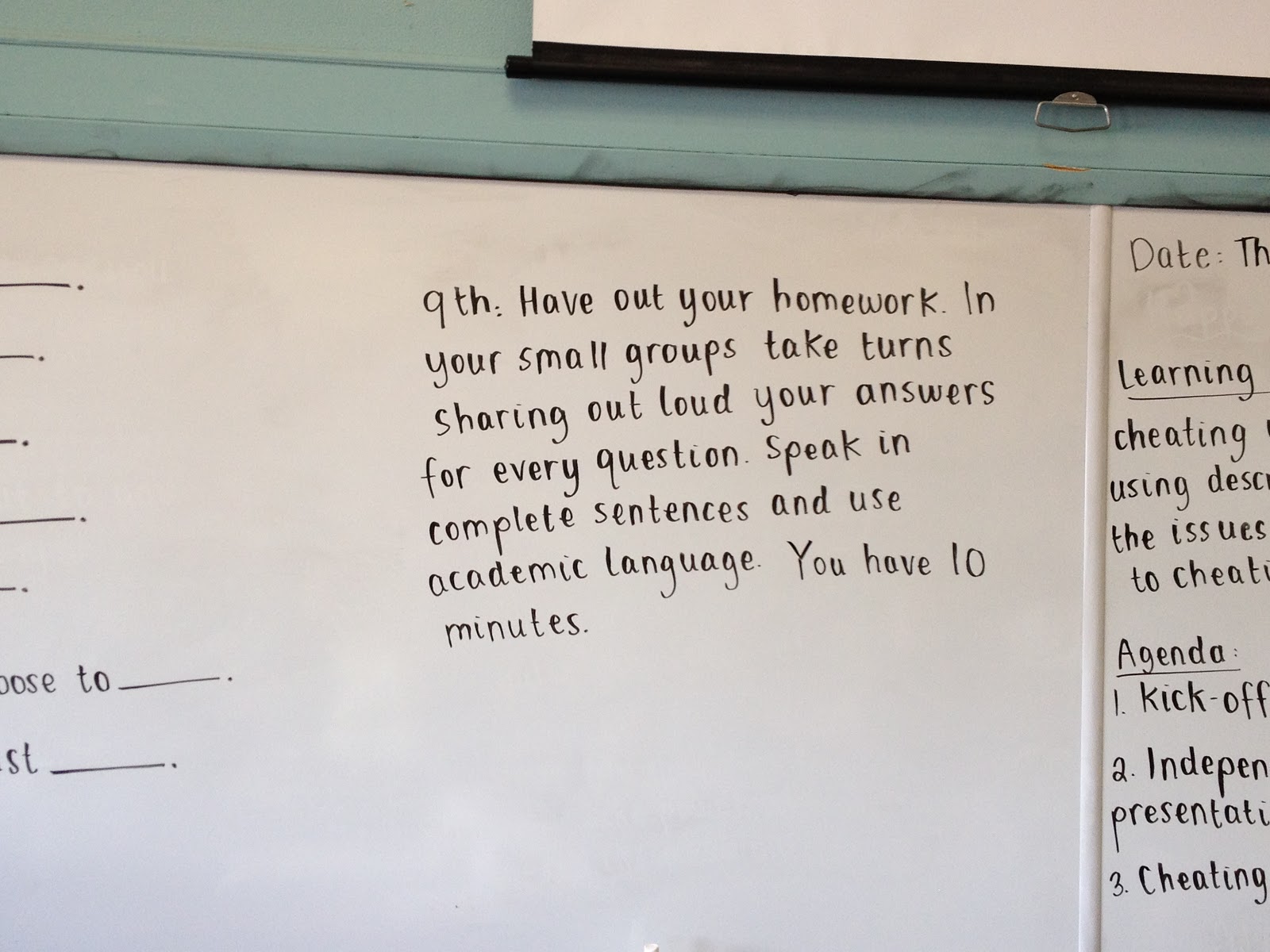
When I observed Ms. Anderson in September, her ninth-grade students (she teaches four sections of ninth grade English) were writing memoirs.  Her "kick-off" instructions on her board read: Have out your memoir notes and your memoir.  Today classmates will be reading your memoir and giving you feedback.  Look over the memoir characteristics in your notes.  With these things in mind, what about your memoir do you want your group-mates to help you with?  Write your needs at the top of your memoir.    Throughout this observation, I noted that Ms. Anderson was confident, relaxed and comfortable with her students – her explanations were lighthearted, funny and sometimes self-deprecating.  When she caught the eye of a giggly student, she smiled and asked him, in wry mock-embarrassment, “Why are you laughing?”  This is typical of her interactions with students, and one of her most endearing qualities.  She then reviewed instructions for peer feedback and lay out parameters for groups.  She gave students a few minutes to get in groups and then used a soft bell to end the group selection process. She explained the facilitator role and handed out peer feedback instructions and an example memoir with her comments.   While the students were in the peer feedback process, she floated around with a clipboard to check group progress, giving students credit for their brainstorm and draft.  At the end of the period, Ms. Anderson asked the students to complete a writing process exit slip incorporating academic language frames as a way to review the stages of the writing process.  It was interesting to note that Ms. Anderson provides these frames with the caveat that "you only have to use these if you need them."  On another observation, I was surprised to see that when she made sentence frame handouts available to her students for essay-writing support and repeated this caveat, an overwhelming majority of her class got up to get a copy of the handout.  

I also had the opportunity to interview some of Ms. Anderson's students, who shared these comments about their teacher:  "She makes learning more fun and interesting."  "She's always really happy, and it makes you happy."  "She's really friendly and very supportive."  "Her happy vibe is contagious."  "She breaks things down if you don't understand."  "She's good at clarifying herself and helping you one on one if you need help." "She'll do anything to help you achieve what you need to achieve."  "In a lot of classes, I don't understand what's going on, but in this class, she explains everything step-by-step."  "It is a challenging class, but she helps you out so that it's easier for you to do the challenging stuff."

Based on my observations, it is easy to see why Ms. Anderson's colleagues nominated her for recognition.  She is creative, energetic, organized, and inspiring.  In a word, exceptional.  Congratulations, Ms. Anderson.  BHS is lucky to have you.


Friday, February 3, 2012

BHS Teachers Make a Difference!

If you don't believe that's true, look no further than this PBS Newshour program, which features Berkeley High graduate Victor Rios (class of 1994).  The last time he was featured on a PBS production, it was a video captured of him in a fight at school in the Frontline documentary School Colors.

Although he grew up in dire poverty and joined a gang, he managed to turn his life around and graduate from high school.  He went on to college, eventually earning his PhD from Cal.  He is now a professor of sociology at UC Santa Barbara.  He says it took the confidence of one teacher - Flora Russ - to help him find a path to academic success.

Watch the program - you'll be glad you did!  Gang Member Turned PhD Mentors Youth on the Fringes

Check out Word Sift!

Thanks to Heidi Ramirez-Weber for suggesting an Academic Language corner, and also for turning us on to this really amazing tool for educators.  It's called Word Sift - it's free and the link is on the right.  Check it out!

Here's more about what it is:

WordSift helps anyone easily sift through texts -- just cut and paste any text into WordSift and you can engage in a verbal quick-capture! The program helps to quickly identify important words that appear in the text. This function is widely available in various Tag Cloud programs on the web, but we have added the ability to mark and sort different lists of words important to educators. We have also integrated it with a few other functions, such as visualization of word thesaurus relationships (incorporating the amazing Visual Thesaurus® that we highly recommend in its own right) and Google® searches of images and videos. With just a click on any word in the Tag Cloud, the program displays instances of sentences in which that word is used in the text.

Thursday, January 12, 2012

Analysis of Academic Language in the New York Times

Thanks to AHA's John Becker for sending us this link!  The Times has analyzed its use of "common expository text structures" and mortar, and it directly relates to what we are doing with academic language this year.  A really helpful article to use with students also:

Compare-Contrast, Cause and Effect, Proposition-Support, etc.

Thursday, December 15, 2011

BHS AP Environmental Science Program - A Model of Project-Based Learning

For the last seven years, students in Ms. Mardi Mertens' AP Environmental Class have been designing architectural models of solar homes based on Solar Energy Education Program design principles.  These models are planned, designed and constructed with the guidance of Ms. Mertens and local architects who visit the classroom and consult with students on their projects.

I had the pleasure to visit Ms. Mertens' class at the end of last semester as her students worked in groups to construct their solar homes from their own original plans (including drawings showing 3-4 separate elevations).  Their homes were required to consider building orientation and include design features such as more South facing windows and fewer North and Western windows, thermal mass, shading, weatherization, ventilation and solar electric array.

Local architects Cate Leger and Greg Van Mechelen then visited the class to offer critiques, and students had the opportunity to make necessary adjustments.  Finally, students were required to compose a museum-quality commentary that accompanied an exhibit installation in the BHS library.

According to Ilse Rueda, a student in the class who now attends San Francisco State University, "I don't think a lot of high school students have ever really studied this in depth - it was fun and also taught us a lot - it's a new idea and it's out there, but we didn't really know how important it was until we had the hands-on experience.  It was valuable to me because now, after the project, I realize that it's really important to conserve energy,  find ways to renew energy that is all around us, and put pressure on our government to make renewable energy sources a priority. It also motivated us to take part in a social issue by engaging us so deeply in the learning and allowing us to take ownership of the project."

Ilse's comments underscore the benefits of the kind of rigorous project-based learning experiences students at Berkeley High enjoy throughout all our small learning communities.  We would like to commend Ms. Mertens for making learning so meaningful for her students.

Would you like to share a best practice or an example of powerful teaching and learning?  If so, email me and I will feature it on this blog!

Tuesday, December 6, 2011

Data needs, etc.

Hi everyone!  Thanks for a productive meeting today.  I wanted to share the questions from our microlabs so that people could post their thoughts to this blog (and perhaps revise their responses after reading the chapter).

1.  Thinking ahead to June, what would a culture of effective  assessment and reflection look like in your department or SLC?  How might classroom instruction be different?

2.  What data would you see your program accessing and/or using at this time (January - March - June)

3.  What actions will be required of your leadership to bring about these changes?  Identify the actions or skills that you will need to develop.

Also, please note that if you want to attend Glenn's workshop on the 13th, there are only five spaces left as of today.  See announcement on the right for more details.

One more thing:  did you know that a small group of us are embarking on an instructional coaching pilot at BHS?  Do you want to be involved, or would you like a coach?  See the article Glenn shared with us, linked at the bottom of this page - "Personal Best," written by Atul Gawande and published in the 10/11 issue of the New Yorker.

Tuesday, November 29, 2011

Driven by Data, Chapter 4

PD Team Leads are reading this book!
One of our goals as coordinators of PD is to build capacity to use data for program improvement.  To this end, we are reading the book Driven by Data by Paul Bambrick-Santoyo. One caveat - we hope to see ourselves through this process not as "driven" but as informed by data. 

In today's meeting, our PD leaders voted to learn more about how to create a culture where assessment and reflection become a regular part of our practice. To help us in our initial discussion of this topic, read Chapter 4 of Driven by Data - then if you feel compelled, please respond to any of the following prompts as a response to this post.

1.  What seemed to be a key factor in building buy-in with the resistant teacher in the opening story?  What do you think about the statement "any initiative that requires complete buy-in prior to implementation is likely to fail"?

2.  Where do you see yourself / your SLC / your department in the phases described on p. 107?

3.  What do you think about the idea of  "building by borrowing"?  Do you think there is potential for us to adapt effective practices from other schools who have been successful (or do you think we have to start from the ground up because we're so weird)?

4.  Do you think the idea to build a leadership team from a combined "expert network" and "trust network" would be a good way to start developing momentum at our school?  Why or why not?